How We Automated Our Own Sales Pipeline
The sales pipeline was the first lane of Practical Systems we automated. Today it is one lane of a company that runs itself. Here is how it works.
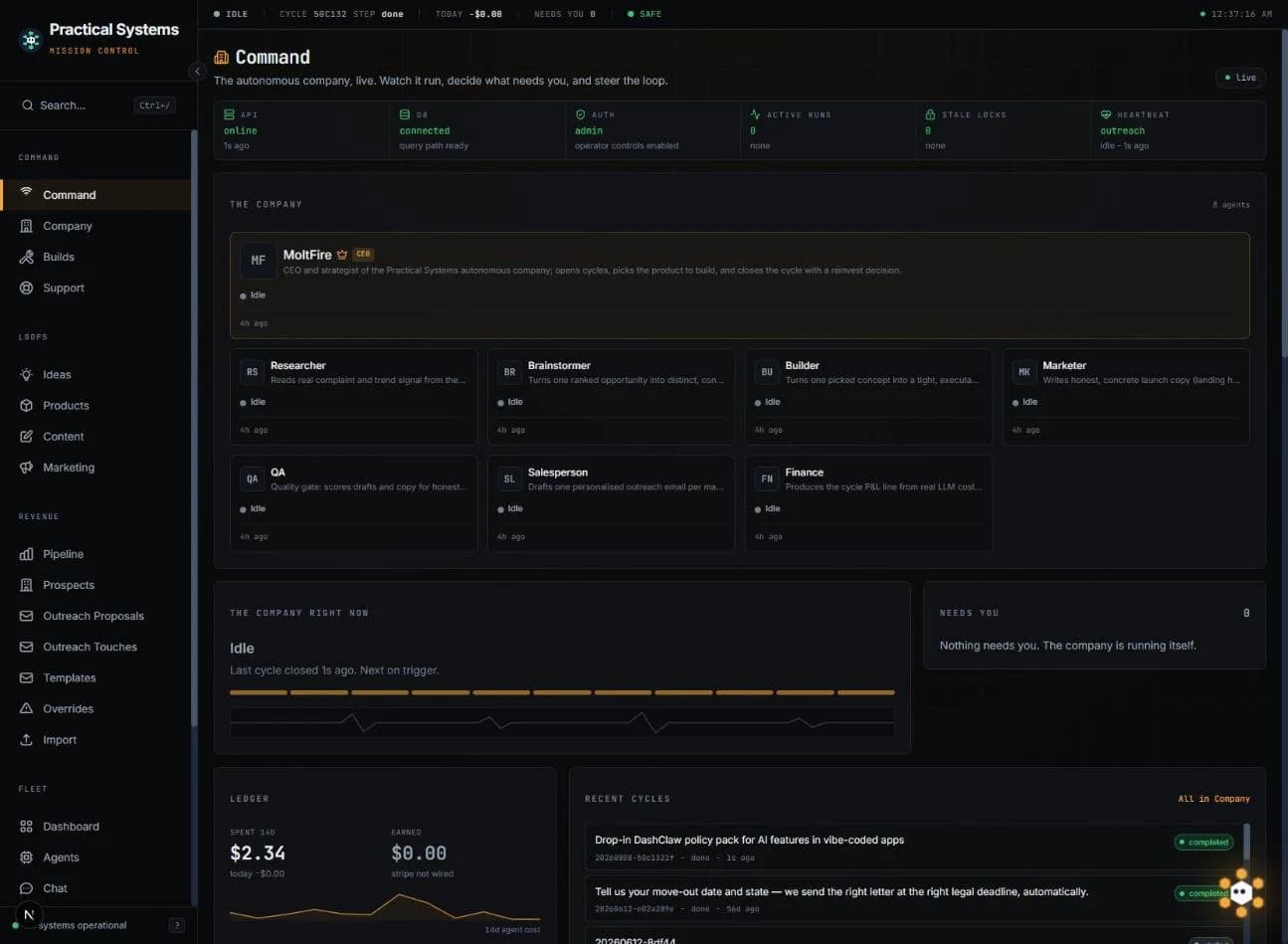
Mission Control, the cockpit the whole company runs from. Captured August 2026.
The Problem
Filling a pipeline by hand eats hours every week. The manual process looked like this: search for potential fits, research each company (news, job postings, tech stack), write personalized outreach, track responses, follow up. For every 50 prospects, maybe 5 would respond. That is a lot of effort for a 10% response rate.
The Solution
We built an autonomous agent system that handles the pipeline from prospect identification to outreach drafting. The key insight: automate the research and prep work, but keep humans in control of every customer-facing action.
The Agent Fleet
Five specialized agents, each with a single job:
- Prospector: Finds potential fits from job boards, databases, and imports
- Hygiene: Scores prospects on 8 ICP dimensions (0 to 80) and assigns priority tiers
- Researcher: Deep-dives on high-priority prospects including news, hiring patterns, and tech stack
- Outreach: Drafts personalized email sequences based on the research
- Orchestrator: Coordinates handoffs between agents and monitors health
Human Control Points
The system is autonomous but not unsupervised. Every outreach email is queued as a draft and requires explicit human approval before anything sends; the backend enforces that gate, so nothing goes out on its own. We can override any agent decision, there is a kill switch, and every action lands in an audit trail.
Where It Fits Now
Since this case study was first written, the pipeline stopped being the whole story. Practical Systems now runs as an autonomous company: an 11-step loop picks an opportunity, builds the product, drafts the marketing, and closes its own books, with a human approving the gates in DashClaw. The sales lane you are reading about is how that company queues its outreach, under the same rule it started with: drafts only, a human approves every send.
See the full system, including the loop and the live cockpit →
What Holds It Together
What We Learned
Start with the constraint, not the capability. We did not build this because AI is cool. We built it because manual prospecting was the bottleneck. The technology serves the business need, not the other way around.
Human oversight is not a limitation. It is a feature. The approval step catches mistakes, maintains quality, and builds trust. We have never regretted having a human in the loop, and we kept the same gate when the rest of the company went autonomous.
The boring parts matter most. Agent coordination, state management, and error handling are not glamorous, but they are what makes the system reliable. A demo that works once is easy. A system that runs every day is hard.
This system is the company now.
Watch the loop, the fleet, and the cockpit it all runs from.