Most AI projects in operations fail. Not because the technology doesn't work, but because companies chase impressive possibilities instead of practical wins.
Here's the reality: 78% of organizations use AI in at least one business function, but most struggle to move beyond pilot projects. The difference between success and failure isn't the sophistication of your AI use cases. It's whether you can actually implement and sustain them.
We've worked with dozens of mid-market ops teams to identify the AI applications that deliver real ROI. The secret isn't finding the most advanced use case. It's matching your AI ambitions to your team's actual readiness level.
This guide cuts through the hype to show you AI use cases that work in practice, not just in theory. You'll learn an adoption-first framework for choosing projects your team can actually execute, with specific tools, costs, and timelines for each readiness level.
Why Most AI Projects Fail in Operations
The AI failure rate in operations is staggering, but not for the reasons you'd expect. It's not about technology limitations or data quality, though those matter. It's about the gap between what's possible and what's practical for your specific team.
Only 45% of organizations with high AI maturity keep AI projects operational for at least three years. That drops to 20% for low-maturity organizations. The difference isn't technical sophistication. It's realistic project scoping and proper change management.
Most ops teams start with the wrong question. Instead of "What can AI do for us?" they should ask "What can we actually implement and maintain?" The companies seeing real results from operational AI focus on adoption first, optimization second.
The pattern is consistent: successful AI implementations start small, prove value quickly, and build organizational confidence before tackling complex use cases. Failed projects do the opposite. They aim for transformation and achieve nothing.
The Three Project Killers
Three factors doom most operational AI projects before they deliver value:
Unrealistic expectations. Leadership sees a demo and expects the same results next quarter. When reality doesn't match the vision, the project loses executive support and dies slowly.
Poor data readiness. AI amplifies your data problems. If your customer records are inconsistent, AI will be inconsistently helpful. If your data lives in silos, AI can't connect the dots you need it to connect.
Lack of team buy-in. The people who'll use the system daily weren't consulted during planning. They view AI as a threat rather than a tool, and passive resistance kills adoption.
The companies that succeed treat AI implementation like any other operational change. They start with clear success metrics, ensure their data is clean enough to deliver results, and get buy-in from the people who'll actually use the system daily.
The Adoption-First Framework
Not all AI use cases are created equal. Some require months of data preparation and significant technical expertise. Others can be implemented in weeks with existing tools and minimal training.
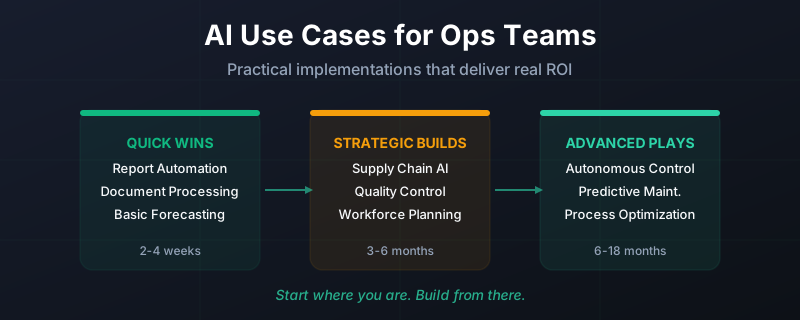
Our adoption-first framework organizes AI implementation into three readiness levels:
| Level | Timeline | Budget | Requirements |
|---|---|---|---|
| Quick Wins | 2-4 weeks | $500-$5K/month | Existing data, minimal setup |
| Strategic Builds | 3-6 months | $25K-$100K | Project management, integrations |
| Advanced Plays | 6-18 months | $250K+ | Dedicated team, proven AI maturity |
The key is honest assessment of where your operations team actually is today, not where you want to be. Start with your current readiness level, prove value, then advance to the next tier.
Most mid-market ops teams should start with Quick Wins, regardless of their ultimate AI ambitions. Building organizational confidence with simpler projects creates the foundation for more complex implementations later.
Quick Wins: Start This Month
Quick Win AI projects share three characteristics: they use data you already have, require minimal technical setup, and deliver measurable results within 30 days. These aren't transformational changes, but they build momentum for bigger initiatives.
The best Quick Win projects solve existing pain points that consume significant manual time. Document processing, basic reporting, and simple forecasting are ideal starting points because they're low-risk and high-visibility.
Automated Report Generation
Operations teams spend countless hours turning raw data into executive summaries. AI can reduce weekly reporting from hours to minutes while improving consistency and accuracy.
Tools like ChatGPT, Claude, or Microsoft Copilot can analyze operational data and generate formatted reports automatically. The setup involves creating templates and data connections, typically taking 2-3 weeks to implement fully.
The math: If your team currently spends 8 hours weekly on reports, automating this saves over 400 hours annually. At $50/hour fully loaded cost, that's $20,000 in savings for a tool that costs under $1,000 annually.
Intelligent Document Processing
Every ops team drowns in documents: invoices, work orders, compliance reports, safety forms. AI can extract key information, categorize documents, and flag exceptions automatically.
Modern document processing tools achieve 95%+ accuracy on structured documents like invoices and work orders. For unstructured documents, accuracy drops to 80-90% but still eliminates most manual processing time.
Implementation typically costs $2-10 per document processed, depending on complexity. For teams processing hundreds of documents monthly, the time savings justify the cost within weeks.
Basic Predictive Analytics
Simple forecasting doesn't require complex machine learning models. AI tools can analyze historical operational data to predict inventory needs, staffing requirements, and maintenance schedules with surprising accuracy.
Start with forecasting use cases where you have 6+ months of historical data and clear seasonal or cyclical patterns. Inventory planning, staffing schedules, and equipment maintenance are ideal starting points.
The key is starting simple. Don't try to predict complex multi-variable scenarios initially. Focus on single-variable forecasts with clear historical patterns, then build complexity as your team gains confidence.
Strategic Builds: 3-6 Month Investments
Strategic Build projects require dedicated project management, technical integration, and change management to ensure adoption. The ROI timeline is typically 6-12 months, making them suitable for companies ready to make meaningful AI investments.
Success with Strategic Builds requires executive sponsorship. These projects will face resistance and technical challenges that need sustained organizational commitment to overcome.
Supply Chain Optimization
Real-time demand forecasting and inventory optimization can dramatically reduce stockouts while cutting carrying costs. AI analyzes multiple data sources including sales history, seasonal patterns, supplier lead times, and external factors to optimize inventory levels continuously.
Implementation requires integrating AI tools with your ERP system and establishing data feeds from suppliers and sales channels. The technical complexity is moderate, but the change management challenges are significant. Purchasing teams must learn to trust AI recommendations over their intuition.
Data requirements: 12+ months of sales history, supplier lead time data, and ideally external factors like weather or economic indicators. Most mid-market companies have sufficient data to start, though data cleaning and integration take 4-6 weeks.
Quality Control Automation
Computer vision AI can detect defects and process variations faster and more consistently than human inspectors. Modern systems achieve 99%+ accuracy on clear defect types while processing hundreds of items per minute.
Implementation requires cameras, processing hardware, and integration with existing production systems. Total costs typically range from $50,000-$200,000 depending on the number of inspection points and system complexity.
The business case is strongest for high-volume operations with clear quality standards and significant costs associated with defects. Industries like food processing, electronics manufacturing, and pharmaceutical production see the highest ROI.
Workforce Planning and Scheduling
AI can optimize staffing levels based on demand patterns, employee preferences, and operational constraints. Advanced systems consider factors like skill requirements, overtime costs, and employee satisfaction to create optimal schedules automatically.
The challenge isn't technical but organizational. Employees often resist AI-generated schedules, viewing them as impersonal or unfair. Success requires careful change management and employee involvement in defining scheduling constraints and preferences.
Implementation typically takes 3-4 months and requires integration with HR systems and time tracking tools. The ROI comes from reduced overtime costs, improved customer service levels, and decreased scheduling administrative time.
Advanced Plays: Enterprise Transformation
Advanced Play AI projects require significant technical maturity, substantial investment, and enterprise-level change management. These use cases deliver transformational results but should only be attempted by organizations with proven success in simpler AI implementations.
The prerequisite for Advanced Plays is organizational AI maturity. Your team should have successfully implemented multiple Strategic Build projects and developed internal AI expertise before attempting these use cases.
Autonomous Process Control
AI agents can make real-time operational decisions without human intervention, optimizing processes continuously based on changing conditions. These systems monitor multiple variables simultaneously and adjust parameters to maintain optimal performance.
Safety considerations are paramount. Implementation requires extensive testing, gradual rollout with human oversight, and robust fail-safe mechanisms. Regulatory approval may be required in some industries.
The business case is strongest for continuous processes with clear optimization targets and high operational costs. Chemical processing, power generation, and large-scale manufacturing are ideal applications.
Predictive Maintenance at Scale
Moving beyond basic maintenance scheduling to true predictive maintenance requires sensor networks, real-time data processing, and sophisticated anomaly detection. Done right, it can reduce unplanned downtime by 50% or more.
This isn't a Quick Win disguised as an Advanced Play. True predictive maintenance requires infrastructure investment, data science expertise, and integration across multiple operational systems. The ROI is substantial but so is the commitment required.
How to Choose Your First Project
Choosing your first operational AI project requires honest assessment of four factors: data readiness, team capacity, budget constraints, and risk tolerance.
The readiness test:
- Do you have clean, accessible data for your target use case?
- Does your team have bandwidth for a 30-90 day implementation project?
- Can you dedicate $5,000-$25,000 to prove the concept?
- Are you comfortable with 80-90% accuracy initially?
If you answered yes to all four questions, you're ready for a Quick Win project. If any answer is no, address those constraints before starting your AI initiative.
The best first projects solve real pain points that consume significant manual time or create operational bottlenecks. Document processing, report generation, and simple forecasting consistently deliver quick wins for operations teams.
Risk tolerance matters more than technical sophistication. Conservative organizations should start with Quick Wins that supplement human decision-making. Risk-tolerant teams can move faster toward Strategic Builds that automate routine decisions.
Start With What You Can Actually Execute
The companies winning with AI in operations aren't the ones with the most sophisticated technology. They're the ones that match their AI ambitions to their organizational readiness and start with projects they can actually execute.
72% of manufacturers report reduced costs and improved operational efficiency after introducing AI tools, but success requires starting with the right use case for your team's current capabilities.
The time to start is now, but the place to start is with realistic expectations. Whether you're ready for Quick Wins or Strategic Builds, the key is taking that first step with confidence that you can deliver results.
Want to assess your operational AI readiness? Our AI audit helps you cut through the hype and identify the best first project for your specific situation. Or book a call to discuss where AI could deliver the most value for your operations team.