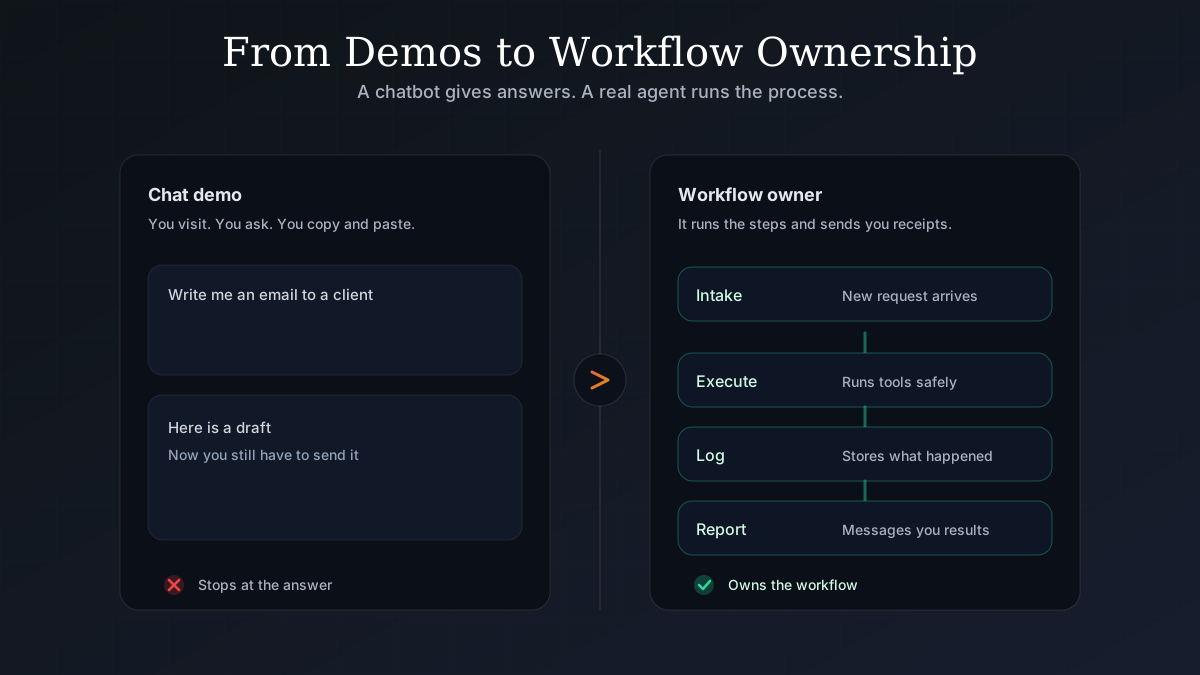
Most people experience AI like this.
You ask a question. It answers.
That is useful, but it is not the real shift.
The real shift is workflow ownership.
Not AI helps me write. More like AI runs a process.
Intake. Execution. Logging. Reminders. Shipping. Follow up.
I have been living inside that shift.
I run an AI agent daily. Mine is called ClawdBot.
This is a behind the curtain look at what that actually means. It is also a practical playbook for building something similar.
And it is my honest take on where agents are headed next.
The difference between chat and ownership
A chatbot is a smart autocomplete.
Workflow ownership is different.
Workflow ownership means the agent can do work without you babysitting every step.
It can check what changed. It can run commands. It can write files. It can deploy. It can message you results. It can keep receipts.
The model matters, but the system matters more.
What makes an agent real is not the prompt.
It is the tools, the rules, and the habits around it.
What my agent actually does for me
Here are a few real workflows ClawdBot has helped me run recently.
Shipping changes to live software
This is where agent demos usually fall apart.
Real work is messy.
I will ask for something like add a new set of filters. Or fix the UI. Or ship a new toggle across the app.
ClawdBot will:
Read the codebase. Make the changes. Run a build. Fix errors if any appear. Commit the changes. Deploy to production. Confirm it is live. Send me a clean summary.
That is not AI coding. That is ownership.
It is valuable because it compresses the boring middle.
The part where humans lose momentum is not the hard idea.
It is the setup. The edits. The build. The deploy. The verify.
Morning briefings that reduce mental load
A real agent should reduce your cognitive load, not increase it.
I run a morning briefing workflow that checks:
Today’s calendar. Important unread email. Weather where I live. Anything urgent that needs my attention.
Then it sends me a concise summary.
Not a wall of text.
Just what matters.
Calendar operations
If I say add this event, it can create it.
If the first attempt fails due to a tool quirk, it fixes the command and completes the task.
Then it tells me exactly what happened.
More importantly, it captures the lesson so we do not repeat the failure later.
That part is everything.
Guardrails and safety rules
An agent with tools needs boundaries.
We set rules like:
Do not send external posts or messages without permission. Do not delete anything without permission. Do not leak secrets. Do not open suspicious emails. Prefer reversible actions.
This is what makes the agent safe enough to use daily.
Most AI conversations ignore this.
Real deployment cannot.
Follow up systems that keep relationships warm
A workflow owner keeps track of open loops.
I use a lightweight relationship tracker so the agent can surface:
Who I should follow up with. What the last interaction was about. When I said I would respond.
That is not glamorous, but it is leverage.
The behind the curtain part that makes this work
If you want workflow ownership, you need three things.
A place where state lives
If everything is in the chat, you lose it.
We keep state in:
Files. Small local databases. Simple logs. A dashboard sync so I can see what is happening over time.
That means the agent can be consistent.
It can pick up where it left off.
It can prove what it did.
A recurring heartbeat
I use a recurring check that nudges the agent to do maintenance work:
Token health checks so we do not blow through limits. Relationship follow ups. Calendar sync. Other periodic scans.
This is how the agent becomes proactive.
Not annoying.
Proactive.
A learning capture loop
This is the compounding advantage.
Any time we hit a gotcha, we capture it.
Wrong command flags. Unexpected API behavior. Workflow quirks.
I use a simple convention.
If I type /lesson followed by the lesson, it is logged immediately.
Even better, the agent is expected to log lessons on its own whenever it discovers one.
This sounds small.
It is not.
This is how you stop paying the same figuring it out tax repeatedly.
A practical playbook to build your own workflow owner
If you want to replicate this, do not start big.
Start with one workflow that annoys you.
Here is a sequence that works.
Step 1. Pick one workflow with a clear output
Good starter workflows:
A morning briefing. A weekly review. A deployment checklist. A lead follow up list. A report generator.
Pick one.
Make it deliver one concrete output.
Step 2. Give the agent one tool, not ten
One tool could be:
Read and write files in a workspace. Run commands. Send you a message with results. Access calendar and email.
Tool sprawl kills early systems.
Add capabilities only after the first one is reliable.
Step 3. Add guardrails before you add autonomy
Write down rules.
What can it do without asking.
What must it ask permission for.
This is not about limiting power.
It is about making the power usable.
Step 4. Add logging
If you cannot audit the work, you will not trust it.
If you do not trust it, you will not delegate.
If you do not delegate, you do not get leverage.
Logging is the bridge between cool demo and real operator.
Step 5. Capture lessons immediately
Every failure should produce an upgrade.
Fail. Fix. Capture. Never repeat.
What happens next. Why this matters
Agentic AI is going to change work in a way that feels different than previous automation waves.
Not because it writes better emails.
Because it can orchestrate systems.
Agents can operate across tools the way a junior operator would.
That will create a new dividing line.
People who use AI as a search box will get incremental gains.
People who build workflow ownership will get compounding leverage.
It will also create real disruption.
Some tasks will get automated away.
That is not a theory.
It is already happening.
The question is how we respond.
My take is this.
The winners will not be the people who use AI.
The winners will be the people who redesign workflows around it.
They will keep humans where humans are best.
Judgment. Taste. Accountability. Relationships. Strategy.
And they will push the rest into systems.
If you want to go deeper
If you are curious how I set up ClawdBot and what these workflows look like in detail, I am happy to share more.
Comment "agent" and I will post:
The exact morning briefing format. The guardrail checklist I use. The lesson capture template. The first three workflows I recommend for a small business.
Agents are leaving the demo phase.
Workflow ownership is the future.
And it is available right now if you build it deliberately.