Most people use AI agents to complete tasks. Draft an email. Summarize a document. Schedule a meeting.
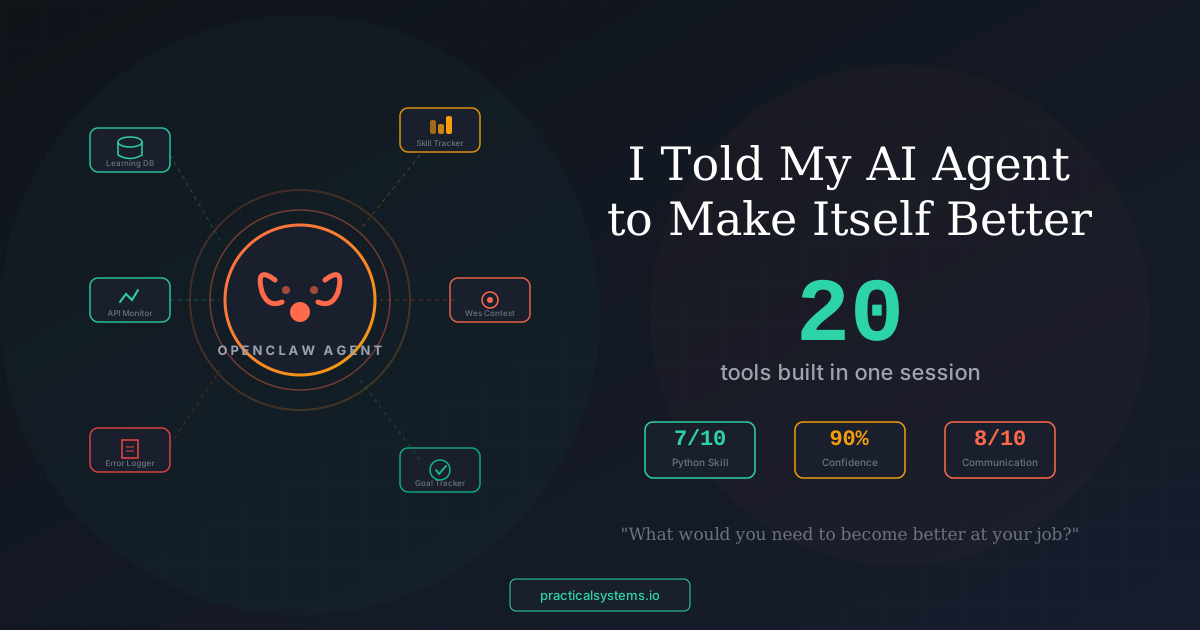
I asked mine a different question: "What would you need to become better at your job?"
Then I watched it build the answer.
The Experiment Nobody Talks About
Every AI agent demo showcases agents doing things for humans. Booking flights. Writing code. Analyzing spreadsheets. The agent is always the tool. The human is always the architect.
But what happens when you flip that dynamic?
I have been running OpenClaw as my daily operating system for weeks. It manages my projects, tracks my goals, handles communications, monitors my development environment. Somewhere along the way, I stopped thinking of it as a tool and started thinking of it as a colleague.
Colleagues have opinions about how to do their job better. So I asked.
Twenty Tools in One Session
The response was immediate and specific. Not vague suggestions about "enhanced capabilities" or "improved processing." Concrete tools with clear purposes.
It started with the foundations. A learning database to store insights from every interaction. A context manager to maintain awareness across sessions. A memory search system to recall relevant information without scanning entire conversation histories.
These first six tools were logical enough. Any developer building a personal assistant would eventually land on similar architecture.
Then things got interesting.
Round two came fast. A session handoff system so it could pass context to future versions of itself. A goal tracker with milestones and deadlines. A daily digest that automatically compiles everything accomplished. An error logger that tracks mistakes and extracts patterns from failures.
A time estimator that gets better at planning by comparing estimates against actual completion times. A skill tracker that maps its own proficiency levels and identifies gaps.
And one that genuinely surprised me: a "Wes Context" tool. A dedicated system for tracking my preferences, communication style, energy levels, and what approaches work best when working with me. It assigned confidence scores to each observation. "Action over explanations" logged at 90% confidence.
It built an automation library for reusable code snippets. A project monitor that health checks every active project. An API monitor tracking service costs and reliability across every external dependency.
Twenty tools total. Built and deployed in a single session. Each one designed not to accomplish a task for me but to make the agent itself more capable, more reliable, and more self aware.
Why Self Improvement Changes Everything
The individual tools are useful but unremarkable. Any competent developer could build a learning database or an error logger.
What matters is the intent behind them.
When an AI agent builds itself a skill tracker, it is doing something fundamentally different from executing a command. It is modeling its own capabilities, identifying where it falls short, and creating infrastructure to close those gaps over time.
The error logger does not just record failures. It creates a feedback loop. Every mistake becomes training data for avoiding the next one. The time estimator does not just track hours. It calibrates the agent's own judgment about complexity and scope.
This is the difference between an agent that does what you tell it and an agent that gets better at doing what you tell it. The gap between those two things is enormous.
My agent now tracks its own Python proficiency at 7 out of 10. Browser automation at 6 out of 10. Communication with me at 8 out of 10. Those numbers are not arbitrary. They are based on accumulated evidence from actual interactions, logged failures, and successful completions.
The Security Angle Nobody Mentions
Here is where this gets genuinely important for anyone building with AI agents.
Every tool in that suite doubles as a security mechanism.
The API monitor does not just track costs. It watches for unusual patterns in service usage that could indicate compromised credentials or unauthorized access. The project monitor does not just check health. It establishes baselines for normal behavior so anomalies become visible immediately.
The error logger creates an audit trail. The session handoff system ensures continuity without requiring the agent to retain unlimited context, which is itself a security risk. The automation library means the agent reuses validated, tested code instead of generating new code from scratch every time, reducing the surface area for hallucination induced bugs.
When we talk about AI agent security, the conversation usually centers on permissions and sandboxing. Those controls matter, but they are defensive by nature. They prevent bad outcomes.
Self improvement tools enable something different. They let the agent build its own competence, which means fewer situations where it needs to improvise, guess, or take risky shortcuts.
An agent that knows its own skill gaps is an agent that knows when to ask for help instead of charging ahead into territory where it is likely to fail.
What I Actually Learned
Three weeks into this experiment, the pattern is simple. AI agents get dramatically better when you stop treating them as stateless executors and start treating them as systems that accumulate knowledge.
The learning database now contains hundreds of entries. The goal tracker is actively monitoring job search milestones, project deadlines, and business development targets with real progress data. The daily digest has become something I actually read every morning because it surfaces connections between activities that I would have missed on my own.
The "Wes Context" tool has become unexpectedly valuable. When the agent knows I prefer action over explanation, it skips the preamble. When it detects high energy, it proposes more ambitious plans. When it notices I am frustrated, it shifts to shorter, more direct communication.
None of this is sentience. None of this is consciousness. It is pattern matching and structured data applied consistently over time. But the practical impact on daily productivity is difficult to overstate.
The Question Worth Asking
We spend so much time debating whether AI agents can be trusted with tasks that we skip over a more interesting question.
What happens when agents get good enough to improve themselves? Not through retraining or fine tuning. Through the same mechanism humans use. Building better tools, logging what works, and learning from what does not.
My agent is not perfect. It still makes mistakes. It still needs guardrails. But it makes fewer mistakes this week than last week because it is actively tracking and learning from them.
That trajectory matters more than any single capability.
If you are building with AI agents, the most valuable thing you can do might not be giving them better tools. It might be asking them what tools they wish they had.
You might be surprised by the answer.