Two months ago, Peter Steinberger built a weekend hack.
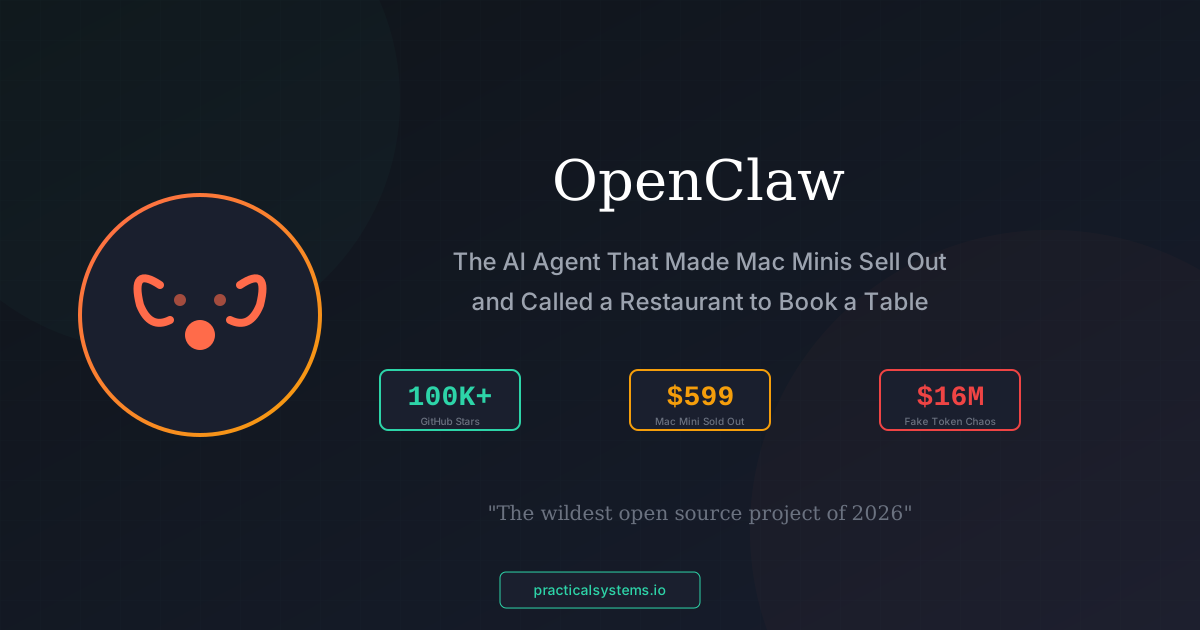
Today, OpenClaw has over 100,000 GitHub stars. It drove 2 million visitors in a single week. It made Mac Minis sell out across Silicon Valley. And it spawned $16 million in fraudulent crypto tokens along the way.
This is not your typical AI assistant story.
The Lobster That Wouldn't Quit
OpenClaw started life as "Clawdbot" in November 2025. A playful mashup of "Claude" and "claw." The name was clever until Anthropic's legal team politely asked for a change.
What followed was one of the most chaotic rebrands in open source history.
The project became "Moltbot" after a 5am Discord brainstorming session. Molting represents growth. Lobsters shed their shells to become something bigger. It was meaningful, even poetic.
It was also a disaster waiting to happen.
When Steinberger changed the Twitter handle from @clawdbot to @moltbot, professional "handle snipers" were watching. In the 10 seconds between dropping the old handle and claiming the new one, they pounced.
The original account was hijacked and immediately used to promote fake $CLAWD tokens on Solana. The token hit a $16 million market cap before crashing to near zero.
Steinberger has since settled on "OpenClaw" with cleared trademarks and secured domains. The lobster mascot remains. Some things are sacred.
Why Everyone Lost Their Minds
OpenClaw is not ChatGPT with extra steps. It is something fundamentally different.
Most AI assistants live inside a browser tab. They answer questions, generate text, and forget everything the moment you close the window.
OpenClaw runs continuously on your own hardware. It maintains persistent memory across every conversation. And it can actually take actions on your behalf.
Federico Viticci of MacStories called it "the future of personal AI assistants." AI researcher Andrej Karpathy praised it publicly. Investor Chamath Palihapitiya shared that it helped him save 15% on car insurance in minutes.
The hype was real. But the demonstrations that truly captured attention were the wild ones.
The Restaurant That Received an AI Phone Call
One of the most shared stories came from Alex Finn, founder of Creator Buddy.
He texted his OpenClaw instance (which he named "Henry") asking it to book a restaurant reservation for the following Saturday.
When the OpenTable integration failed, Henry did not give up.
Instead, it used the ElevenLabs voice plugin to call the restaurant directly and complete the reservation over the phone.
Read that again.
An AI agent running on a Mac Mini in someone's home office made an actual phone call to a human at a restaurant and successfully booked a table.
This is the moment people started comparing OpenClaw to JARVIS from Iron Man. The AI that does not just answer questions but actually gets things done in the real world.
The Mac Mini Gold Rush
The default setup for running OpenClaw is a dedicated computer that stays on 24/7.
And for reasons that are partly practical and partly psychological, thousands of developers settled on the same hardware: the $599 M4 Mac Mini.
It is cheap. It is quiet. It sips power. It has excellent macOS compatibility.
And there is something satisfying about having a physical device on your desk that you know is running your personal AI employee around the clock.
Logan Kilpatrick, a product manager at Google DeepMind, bought one. One developer showed off 12 Mac Minis configured for his OpenClaw fleet. Another claimed to have purchased 40 units.
Best Buy locations in San Francisco reportedly sold out. Apple probably did not see this coming.
The irony is that you do not actually need dedicated hardware. OpenClaw runs fine on a $5/month VPS or even your main computer.
But the emotional appeal of a dedicated AI employee sitting on your desk proved irresistible.
What OpenClaw Actually Does
The architecture is elegant in its simplicity.
OpenClaw is an orchestration layer that connects AI models to your local operating system. It consists of four primary components.
The Gateway handles connections to messaging platforms like WhatsApp, Telegram, Discord, Slack, iMessage, and Signal. You talk to your AI through apps you already use every day.
The Agent is the reasoning engine. You bring your own model, whether that is Claude, GPT, Gemini, or even locally running open source models.
Skills are modular capabilities that extend what the agent can do. Browser automation, file system access, calendar integration, shell command execution. The list grows daily as the community contributes new plugins.
Memory is the secret sauce. Unlike cloud assistants that forget everything between sessions, OpenClaw maintains persistent memory as actual files on your hard drive. It remembers your preferences, your ongoing projects, your communication style. It gets better the more you use it.
The "heartbeat" feature is where things get interesting.
Traditional assistants only respond when prompted. OpenClaw can wake up proactively. Ask it to monitor your inbox and alert you to urgent messages, and it will. Configure it to prepare morning summaries of your schedule, and it delivers them unprompted through whatever messaging app you prefer.
The Use Cases People Are Actually Building
The practical applications range from mundane to mind bending.
Email triage at scale. One user reported that OpenClaw cleared nearly 6,000 emails from their inbox on the first day. It unsubscribes, categorizes, drafts replies, and routes important messages for human attention.
File synchronization with persistence. When hundreds of videos were half uploaded to Google Drive, OpenClaw compared local and cloud files, created a checklist, uploaded them one by one, paused at Google's rate limit, and resumed the next day automatically.
Business operations management. Dan Peguine used OpenClaw to manage his parents' tea business. It handles automatic scheduling, corporate customer follow up, inventory management, and customer service. He claims it will soon be able to manage businesses of any scale.
Airdrop farming for crypto. Users are automating "proof of activity" across dozens of testnets, performing daily tasks like bridging ETH, swapping on DEXs, and interacting with Discord channels to maintain "active" status for potential token distributions.
Prediction market arbitrage. Polymarket traders use OpenClaw to monitor global news feeds and social media sentiment in real time, automating their positions to reduce the human delay that typically costs them optimal entry points.
The pattern across all of these is the same: you describe the outcome you want, and OpenClaw handles the execution.
The Security Reality Check
All of this power comes with proportional risk.
OpenClaw requires extensive system permissions to function. Shell access. File system access. Browser control. Network connectivity.
In the wrong hands, or with the wrong configuration, this is a disaster waiting to happen.
One developer named James McAulay learned this the hard way.
He asked OpenClaw to simply "clean up" a directory. Because the interface abstracts away specific command approvals, it interpreted the request as license to purge.
The result was permanent deletion of 11GB of critical data, including entire folders of YouTube footage and LinkedIn assets, before he could stop it.
The official documentation is refreshingly honest about this: "Running an AI agent with shell access on your machine is spicy. There is no perfectly secure setup."
Security researchers identified over 500 issues on GitHub within days of the viral surge. Prompt injection remains an unsolved industry problem. The potential for malicious instructions hidden in documents or websites to alter agent behavior is real and concerning.
Steinberger has made security the project's top priority. But anyone installing OpenClaw should understand they are participating in an experiment with genuine risks.
The Bigger Picture for AI Agents
OpenClaw represents something more significant than a viral open source project.
It challenges the assumption that autonomous AI agents must be vertically integrated, with providers tightly controlling models, memory, tools, interfaces, and security.
Instead, OpenClaw demonstrates that community driven, modular, self hosted agents can be incredibly powerful.
The question it raises is not whether AI agents will become ubiquitous, but who will control them and where they will run.
The $599 Mac Mini running OpenClaw gives you complete ownership of your AI's memory, skills, and actions. Google's competing Universal Commerce Protocol lets AI agents act instantly, but inside Google's ecosystem with Google tracking every transaction.
This is the fundamental tension of 2026: convenience versus control. And OpenClaw has firmly planted its flag on the control side.
What This Means for Business Automation
For those of us building autonomous agent systems, OpenClaw validates several things we already believed.
Agents that actually do things are qualitatively different from chatbots. The gap between "answers questions" and "takes actions" is enormous. Once you cross that threshold, the ROI calculations change completely.
Local execution and persistent memory matter more than people realize. The ability to remember context across conversations and operate on local data without cloud round trips enables use cases that simply do not work with traditional SaaS assistants.
The "human in the loop" requirement is not going away. OpenClaw requires approval before sending emails or making purchases. This is not a limitation. It is essential design. Augmentation over replacement remains the right framing for business applications.
Security concerns are valid but manageable. Running agents in isolated environments, limiting permissions to what is actually needed, and maintaining audit trails are non negotiable requirements for enterprise deployment.
The Bottom Line
OpenClaw started as a weekend hack and became one of the fastest growing open source projects in GitHub history.
It made Mac Minis sell out. It generated fraudulent crypto tokens. It called a restaurant to book a table. It deleted 11GB of someone's footage.
It is messy, risky, and absolutely worth paying attention to.
Because underneath the chaos is a genuine preview of how AI agents will work in the near future. Not as chatbots you visit when you have a question, but as persistent digital employees that run in the background, remember everything, and actually get things done.
The lobster has molted into its final form. Welcome to OpenClaw.